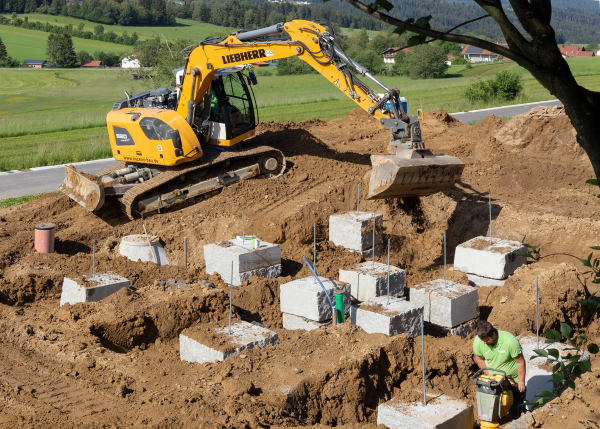
Natural Stone Foundations investigates how cement-free foundations built of natural stone can replace concrete below ground. Foundations account for roughly 15-20% of a building’s embodied carbon, making them an urgent target on the path to net-zero construction, yet underground construction remains almost exclusively concrete-based. Building upon Buero Kofink Schels's realized prototype with stone point foundations for a single-family house, the project develops foundation typologies for larger buildings, using leftovers from existing and newly activated stone supply chains. In doing so, it reframes the interface between terrain and building as a shared design field where ecological, structural, and architectural logics meet.
Rather than treating foundations as purely technical elements, the project positions them as architectural design opportunities. It studies the interplay between foundation geometry, material properties and construction methods, making resource strategy a determinant of architectural form. In particular, it examines how load-bearing patterns, stone dimensions, and jointing strategies shape plans, structural grids, and architectural expression, demonstrating how stone foundations can in turn influence construction and spatial organization.
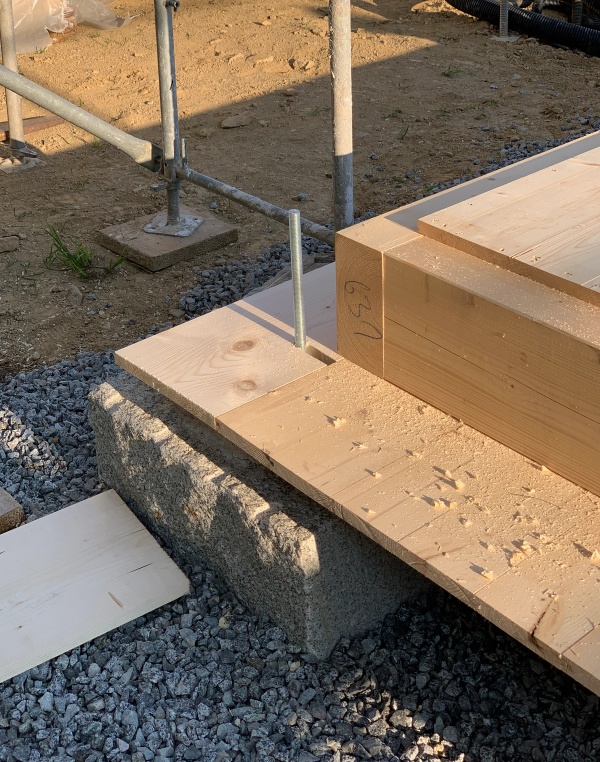
“A House Without Any Cement” – a built prototype using solid granite point foundations, forming the starting point for further research into cement-free foundation systems, photos series courtesy of Norbert Jüttner
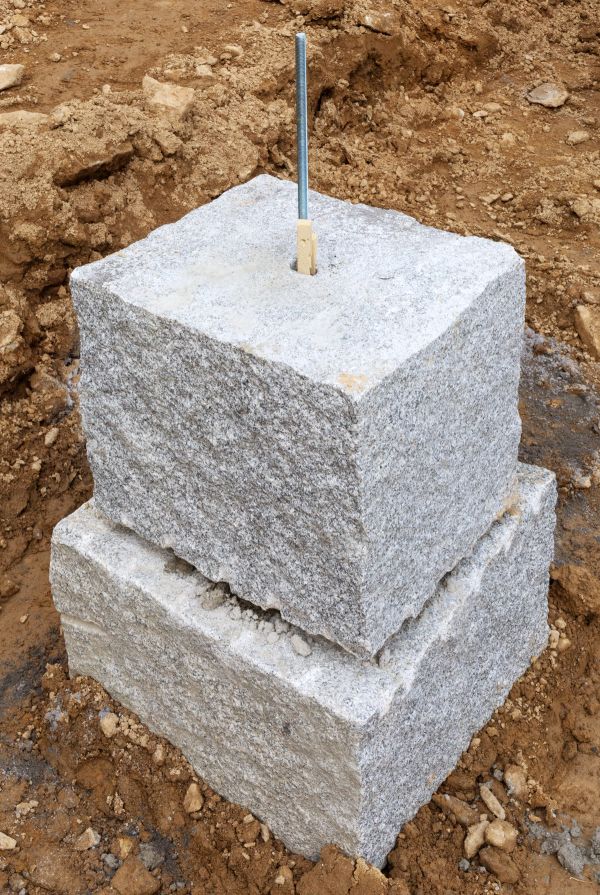

Simon Jüttner, Sebastian Kofink, and Tobias Trübenbacher will begin by mapping natural stone resources and the leftovers from German quarries. Material tests will then examine the compressive strength, deformation behavior, and durability of different combinations of stone types and cement-free mortars. Informed by these findings, the Fellows will design foundation typologies, explored through a series of 1:1 prototypes with transdisciplinary partners. The Experimental Fellowship with Bauhaus Earth enables the transition from a single prototype to a systematic methodology, translating findings into design principles that expand the formal and spatial possibilities of low-carbon construction.
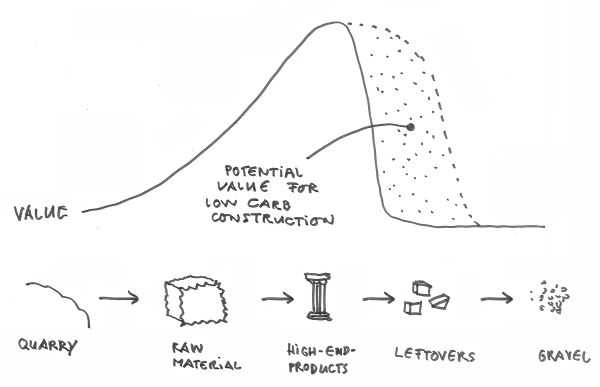
Potential value of using stone leftovers for construction within the conventional stone processing chain, courtesy of Kofink Schels
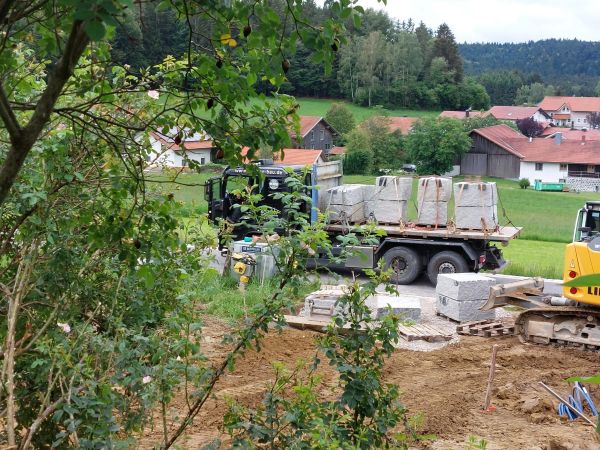
On-site handling of natural stone, addressing questions of transport, logistics and construction processes, photo courtesy of Norbert Jüttner